
What Happened in 1971
Wages stopped growing. Women were told to go to work. Draw your own conclusions.

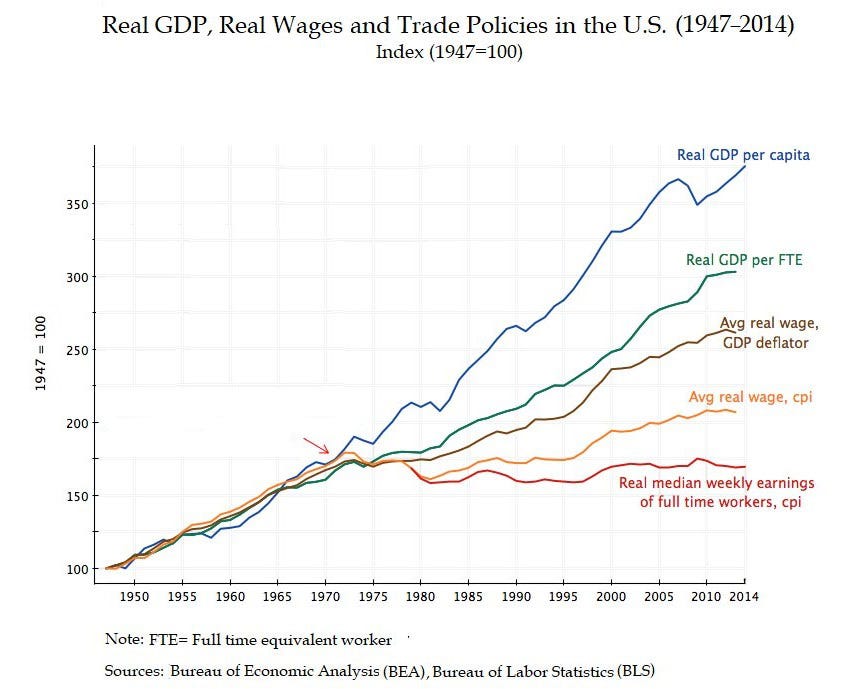
I want to share a sequence of events with you. I am not going to tell you what to make of them. I am going to lay them out in order and let you decide.
In August 1971, President Nixon ended the convertibility of the US dollar to gold. This is called the Nixon Shock. It is one of the most significant economic events of the twentieth century and one of the least discussed outside of financial circles.
Almost immediately afterward, something changed in the American economy that has never been reversed. And in the same decade that it changed, the feminist movement achieved its most significant legislative victories and the cultural narrative about women, work, and the family was rewritten from the ground up.
I am not saying those two things are connected. I am saying they happened at the same time, that the numbers are what they are, and that the people who benefited most from both developments are worth identifying.
The Decoupling
From 1948 to 1971, wages and productivity in the American economy grew at almost exactly the same rate. As businesses became more efficient and produced more output per worker, workers were paid more. The relationship was not perfect but it was consistent. When the economy grew, workers shared in that growth.
According to the Economic Policy Institute, from 1948 to 1971 hourly compensation grew approximately 82% while net productivity grew approximately 87%. Close enough to call it a partnership.
Then it stopped.
From 1971 to 2015, productivity grew 241%. Hourly compensation grew 112.5%. The lines that had tracked together for twenty-three years separated and never came back together. American workers kept getting more productive. American workers stopped getting paid for it.
This is not a political argument. These are Bureau of Labor Statistics numbers run through Economic Policy Institute analysis. The decoupling happened. It happened starting in 1971. No serious economist disputes the data.
What happened to all that productivity growth that stopped flowing to workers? It went somewhere. It flowed upward - to shareholders, to executives, to the financial system that was restructured when the dollar was cut loose from gold. The working and middle class produced more and kept less of what they produced. Year after year. Decade after decade.
By the time you account for this divergence, the median American worker is significantly less compensated relative to their economic contribution than their counterpart was in 1970. Not because they work less hard. Not because they produce less. Because the arrangement changed.
What the Feminist Movement Won in the Same Decade
In 1972, Title IX passed.
In 1973, Roe v. Wade.
In 1974, the Equal Credit Opportunity Act - giving women independent access to credit for the first time.
The ERA push was in full force. Women flooded into universities and then into the professional workforce in numbers that had never been seen before. Female labor force participation climbed from roughly 43% in 1970 toward the 57-60% range it occupies today. In the span of a decade, the available labor supply in the United States nearly doubled.
I want to be precise about what I am saying here. I am not saying that women should not work, should not have credit access, or should not participate in civic life. I am saying that from a basic supply-and-demand perspective, when you double the supply of labor without a corresponding increase in demand for it, the price of labor goes down. This is not ideology. It is arithmetic.
The feminist movement told women that entering the workforce was liberation. What it was, arithmetically, was a massive expansion of the labor supply at exactly the moment when the economic arrangement had been restructured to stop sharing productivity gains with workers. Women entered the workforce just in time to help bid down the wages that the restructured system was already suppressing.
The Number That Should End the Argument
In 2003, a Harvard Law School professor named Elizabeth Warren - you may have heard of her - published a book called The Two-Income Trap with her daughter Amelia Warren Tyagi.
Elizabeth Warren is not a conservative. She is not a red pill thinker. She has spent her career as one of the most prominent progressive voices in American politics. She wrote this book before she became a senator, when she was still primarily a bankruptcy researcher looking at why middle-class American families were going broke in such large numbers.
Her findings were, in her own words, astonishing.
Today’s two-income family earns 75% more money than its single-income counterpart of a generation ago. And yet it has 25% less discretionary income to cover living costs.
Read that again.
The family with two incomes - the family that sent both parents to work to get ahead - earns dramatically more in nominal terms than the one-income family of the 1970s. And it has less money left over at the end of the month.
Warren and Tyagi documented why. The second income did not create financial cushion. It created a bidding war. When two-income families entered the housing market, they bid up home prices. When they competed for spots in better school districts, they bid up the cost of entry into those districts. The fixed costs - mortgage, housing, education - absorbed the second income entirely and then some. And now families that had structured their lives around both incomes were more financially vulnerable than one-income families had been in the 1970s, because they had no income buffer. If one earner lost a job, there was nothing left to cut.
The second income, which was supposed to liberate women and provide financial security, became the minimum viable requirement for maintaining middle-class status. It did not lift the boat. It raised the water level.
The Trap
Here is what this means in practice for the people living it.
The stay-at-home mother of 2024 is not the stay-at-home mother of 1970. In 1970, a median-income single earner could purchase a median-priced home, support a family, and maintain a reasonable middle-class existence. The math worked.
Today, the median US home costs more than five times the median household income. In major metropolitan areas it is signfiicantly higher. The single-income family that tries to maintain the life that single-income families lived in 1970 is attempting something that the economic restructuring of the last fifty years has made nearly impossible for the median earner.
This is why the Gallup data on stay-at-home mothers shows elevated rates of depression and sadness. I covered this in my last article. The researchers presented it as evidence that staying home is bad for women. What the data actually shows is that being financially trapped is bad for everyone. Women who are at home because the childcare math doesn’t work, because one income isn’t enough, because they’re watching the family budget bleed out month after month - those women are not a study on the psychological effects of homemaking. They are a study on the psychological effects of financial destruction.
The woman who is home because she chose it, because the family is financially secure, because she is doing what she genuinely wants to do - she reports the best outcomes of any group in the research. I showed you the Ciciolla data on this. The variable was never employment status. The variable was financial stress, and beneath that, the structural transformation of the economy that made financial stress the default condition of the American family.
Cui Bono?
I am going to ask you a question that I cannot answer with certainty, and I am going to ask it because it deserves to be asked.
When the labor supply doubles, wages are suppressed. When wages are suppressed, workers need more income to maintain the same standard of living. When families need more income, both adults work. When both adults work, they need childcare, prepared food, cleaning services, and every other domestic function that was previously performed within the household. Each of those functions becomes a commercial transaction. Each commercial transaction generates revenue for corporations and tax revenue for governments.
The feminist program took the most economically significant unit of production in human history - the household, which produced food, childcare, education, and domestic services internally - and dissolved it. Every function the household previously performed for itself became something families had to pay someone else to provide.
I am not saying this was designed. I am saying it was the outcome. And I am saying that the people who benefited from that outcome were not the women who were told it was liberation.
In The Top Shelf Man, I lay out the unplugging framework in detail. The principle is simple: follow the money. Follow the incentive. Find out who benefits from the story being told and you will know something important about why the story is being told.
The story told to women for fifty years was: work is freedom. Dependence on a husband is weakness. The traditional family was a prison. Your liberation is in the workforce.
The people who benefited from that story were not women. They were the employers who gained access to a doubled labor supply. The governments that gained tax revenue from a second earner per household. The corporations that gained customers for every domestic service the dissolved household no longer performed internally.
Women gained access to careers. They also gained a second mandatory income, the dissolution of the buffer that protected one-income families from financial catastrophe, a bidding war that consumed their earnings before they arrived, and a cultural narrative that told them this was progress.
What Men Need To Understand
I am not writing this so that men can resent women. I am writing it so that men can see the system clearly.
The system that destroyed the middle-class family did not do so by accident. The economic restructuring happened. The labor supply expansion happened. The cultural reframing happened. The fixed costs absorbed the gains. The households dissolved. The commercial replacements profited.
The men who are trying to build a family today are trying to build it on economic terrain that was deliberately restructured to make it harder. The housing market is what it is. The wage picture is what it is. The cost of raising a family is what it is.
The unplugged man understands that these are not random conditions. He plans accordingly. He builds income streams that are not subject to a single employer. He acquires assets. He builds location independence where possible. He understands that the system as currently structured is not designed to help him build the life he wants, and he stops waiting for the system to change.
The game is not fair. It was not designed to be fair. Knowing that is the beginning of building something real anyway.
In Conclusion
From 1948 to 1971, wages and productivity moved together. From 1971 onward, they did not. In the decade that followed, the feminist movement reshaped the cultural narrative about women and work. Women entered the workforce in unprecedented numbers. The labor supply expanded dramatically. Wages were further suppressed. The second income became necessary. The household dissolved into commercial transactions. The families that structured themselves around two incomes became more financially vulnerable than the one-income families of a previous generation.
Elizabeth Warren wrote the book on this in 2003. She is a progressive feminist senator. The data is the data regardless of who found it.
I am not telling you what to conclude. I am telling you that the numbers are real, the timing is what it is, and that anyone who benefits from a narrative gets to be questioned about their interest in that narrative.
The comforting lie here is that everything that happened was liberation. The uncomfortable data is in the productivity charts and in Elizabeth Warren’s bankruptcy research. You just read it.
The Cold, Hard Truth
Never forget:
From 1948 to 1971, wages and productivity grew together. After 1971, productivity grew 241% while hourly compensation grew 112.5%. The arrangement that rewarded workers for their output was restructured. The year it changed is not ambiguous.
In the same decade, the feminist movement achieved its major legislative victories and female labor force participation began its sustained climb from 43% toward 60%. The labor supply of the American economy expanded dramatically at exactly the moment wages began their long decoupling from productivity.
Elizabeth Warren and Amelia Warren Tyagi documented in 2003 that today’s two-income family earns 75% more than its single-income counterpart of a generation ago and has 25% less discretionary income. The second income did not create financial security. It created a bidding war for housing and education that consumed the gains and left families more financially vulnerable than before.
The stay-at-home mother who reports elevated depression in the Gallup data is not reporting the effects of staying home. She is reporting the effects of financial destruction. When you control for financial stress and preference alignment, women who chose to stay home report the best psychological outcomes of any group in the research. The variable was never employment status.
The household was the most economically significant unit of production in human history. It produced food, childcare, education, and domestic services internally, at no commercial cost. Its dissolution converted those functions into commercial transactions generating revenue for corporations and tax receipts for governments. Follow the money.
The game was restructured before you arrived. The man who knows this builds accordingly - multiple income streams, assets, location independence, and zero dependence on a system that was not designed to help him build the life he wants.
Peace.
The full anti-fragility and unplugging framework for navigating exactly this environment is in The Top Shelf Man and The Unplugged Alpha.
The School of Unplugging is where men who are building accordingly gather.
Disclosure: As an Amazon Associate I earn from qualifying purchases.
The big bang of degeneracy!
Postmodernism, critical Marxist theories, and feminism achieved the unholy trinity forged into a ring to rule them all.
Western civilization has been hollowed out ever since.
So clearly said! You can’t not see the full picture and not wonder if it was in fact the plan. 🤷♀️