
What Happened at the 1% Forum 2025 - Part 1
The uncomfortable side of chasing excellence - it eventually turns on your own beliefs.

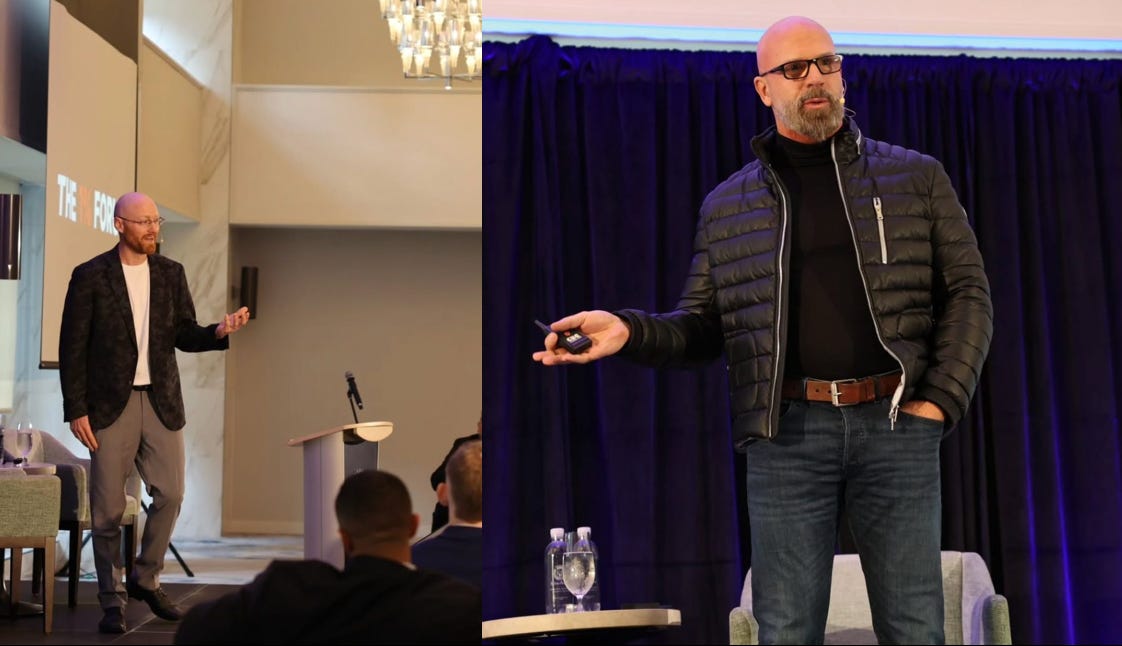
Last October I gathered a small group of men in Toronto for what I call the 1% Forum. No livestream. No replay for the masses. You either show up or you miss it. The format is simple - I bring in men who are operating at an exceptional level in their respective fields, put them on a stage in front of an equally exceptional audience, and let things get real.
Last year was the best one yet.
Over two days, top speakers covering territory that most men never get access to in one room - relationship dynamics, divorce forensics, real estate leverage, software entrepreneurship, testosterone optimization and metabolic health, AI implementation, wilderness leadership, publishing strategy, and brotherhood culture. Some of it was uncomfortable. A lot of it was actionable. All of it was the cold hard truth.
I’m going to share some of what went down across two articles. This is Part 1 - the external world. Money, legal protection, the sexual marketplace, technology, and the frameworks men need to navigate all of it without getting destroyed.
If you want access to the full presentations, they’re inside the School of Unplugging. But start here.
Chris Kelly - The Talk Nobody Expected
Chris Kelly runs Driftwood Paddle, a wilderness guide company that leads men’s backcountry retreats in Canada. He was the forum’s wildcard and, for a lot of men in that room, the most impactful speaker of the weekend.
His talk wasn’t about tactics. It was about what becoming a strong, capable man actually requires - and his answer was not what most men in that room expected to hear.
He told four stories. The one that landed hardest was about his father.
Kelly had carried a difficult relationship with his dad for years. He described the moment he learned to separate sensation from story - the somatic technique of letting a triggered emotional response rise and fall through your body rather than immediately reacting to it. That shift transformed the relationship. On a car ride, he told his father he was proud of him. His father, in turn, revealed something he had never shared: he lost his own father at eleven years old and had been carrying that alone ever since.
Kelly called it “carrying your torch” - acknowledging the sacrifices of the men who came before you and running the torch further than they could.
The room was quiet in a way that rooms don’t usually get quiet.
His other stories covered a coin-flip decision to leave a high-paying pipeline job in Australia for the Solomon Islands, a rickshaw trip across India where the plan was essentially to break down and trust whatever happened next, and the chain of seemingly random decisions that led him to founding Driftwood and eventually standing on that stage. His point was that you cannot always connect the dots looking forward. You can only follow what’s calling you and trust that the dots will make sense in retrospect.
“Becoming a strong and capable man is so much more than lifting weights.” He said it straight. “Becoming a strong, capable man is going inside and asking, what do I want out of this life?”
I’ve sat across from thousands of men on coaching calls. Most of them are looking for tactics. Kelly reminded everyone in that room that tactics built on a shaky foundation don’t hold. The internal work is not optional.
Orion Taraban - Why You Keep Losing the Game You Think You’re Playing
Dr. Orion Taraban is a licensed psychologist, author of Man on His Own, and one of the most analytically rigorous thinkers on intersexual dynamics operating today. His Psych Hacks brand reaches over ten million people monthly. I’ve had him on the channel and he’s one of the few people I’ll sit across from and actually take notes.
His 1% Forum talk was a masterclass in relationship economics, and it started with a line that I want you to sit with.
“It’s not the good or the loving or the virtuous who are rich in relationships. It’s the people from whom others want things.”
He framed every human relationship as an exchange of unequal things of comparable value. Not a moral transaction, not a romantic one - an economic one. When you understand this, a lot of things that used to confuse you start making sense.
The central paradox he laid out is this: satisfying someone’s needs makes you redundant. But withholding indefinitely causes them to leave. There is no static equilibrium. There is only managed distribution - giving enough to keep them engaged, holding back enough to keep them wanting. He compared it to a corporate promotion ladder with eighty-seven levels. No one keeps working when they’ve hit the ceiling. The art is making sure they never see the ceiling.
He called it the plumber paradox. Nobody continues to pay the plumber once the pipes are fixed.
His prescription for men: compress early, never expand. You can always give more over time, but you cannot take back what you’ve already given. “With women, you can always compress, but you can never expand.” Start minimal. Make her earn the next level.
On attraction, he made the case for Instagram not as a vanity tool but as what he called a “curated gossip brochure” - eight to twelve professional-grade photographs that communicate a lifestyle and let women do what they’re already doing anyway, which is evaluating men indirectly through social proof. He distinguished between the social validation approach (twenty thousand followers) and the curated website approach (small, intentional, high-quality). The latter is more effective for most men because it’s specific enough to be believable.
The talk closed with something I’ve been saying for years from a different angle. The less you care what a woman thinks of you, the more interested she becomes. Taraban put the psychological framework underneath it. “Any woman that I would give an exclusive commitment to wouldn’t need the exclusive commitment in order to stay.” If the commitment is the thing holding her there, you don’t have what you think you have.
Jason Hartman - The Real Estate Market is the Dating Market
Jason Hartman has been investing in linear market rental properties across eleven states and seventeen cities for over twenty years. He hosts one of the longest-running real estate podcasts in existence and created frameworks that I’ve found genuinely useful for thinking about markets of all kinds.
His talk was nominally about real estate. It was actually about one question that he argues is the most important question in life.
“Compared to what?”
Nothing has meaning in isolation. Housing prices up 93% over ten years sounds alarming until you apply leverage: with 20% down, that same appreciation becomes a 465% return on invested capital. In what he called “ludicrous mode” - 15% annual appreciation - leveraged real estate nets 72% annually after inflation. The number doesn’t mean anything until you compare it to something.
He applied this to the dating market with a precision that made several men in the room visibly uncomfortable. He walked through what he calls the qualifying funnel - filtering the available female population by age range, healthy weight, education level, mental health, tattoos, and OnlyFans - and showed, using the Female Delusion Calculator and Aaron Clary’s framework from Book of Numbers, that the resulting pool is vanishingly small. Men are not imagining that things have changed. The data confirms it. “Compared to what?” - compared to what the market looked like for their fathers and grandfathers - the answer is ugly.
His most original contribution was what he calls inflation-induced debt destruction. If you borrowed a million dollars in mortgages five years ago, you effectively only owe seven hundred thousand in real dollars today, because the dollar itself has lost thirty percent of its purchasing power. Inflation silently transfers wealth from lenders to borrowers. The man who owns leveraged real estate benefits from every dollar the government prints. The man who saves cash gets systematically robbed.
He traced the roots of this all the way back to the government’s incentive to inflate away its unfunded obligations, which he puts at $220 trillion. The options are default, raise taxes, sell assets, steal, innovate, or inflate. They will inflate. They always inflate. The question is only whether you’re positioned on the right side of it.
His closing argument was simple: the US real estate market is uniquely favorable because of government-subsidized 30-year fixed mortgages - the lowest interest rates in five thousand years of recorded history - combined with transparent MLS data and default property rights. No other country offers this combination. If you are a man building wealth and you are not taking advantage of leveraged US real estate, you are leaving the single best asymmetric trade in the world on the table.
Ryan Benson - The Four Types of Ex-Wife (And How Each One Can Destroy You)
Ryan Benson is a forensic accountant with more designations than I have time to list - MBA, CPA, CA, CBV, ABV, CFE, CFF - and he is cross-designated as an expert witness in both the United States and Canada in divorce proceedings. He runs the “Stay Rich Divorce” brand and has sat at the expert witness table in more high-net-worth divorces than most men will ever know exist.
His talk was the most practically useful thing I have ever seen presented at a men’s event on the subject of protecting your assets. I am not exaggerating.
He opened with a term he coined: “klepto-bismol.” She takes your shit and you feel sick. It got a laugh. The rest of the talk did not.
His framework organizes women in divorce into four types. Type 1 - roughly fifteen percent of cases - is cooperative. She wants security. She’ll negotiate reasonably. Type 2 - about twenty-five percent - is the smart professional who wants her fair share and will negotiate firmly but rationally. Type 3 - forty percent - wants to burn it all down, not because she’s calculating but because she’s angry. Type 4 - fifteen percent - wants to destroy your entire life, including your business, your reputation, and your relationships with your children.
Most men assume they’re dealing with a Type 1 or 2. Benson’s advice: assume Type 3 until proven otherwise, and have your defenses in place before you need them.
The first line of defense is a cohabitation agreement before you live together, and a prenuptial agreement before you marry. Not after things go sideways. Before. Full disclosure of assets and liabilities is mandatory - hide something and the agreement is void. He was emphatic: if she refuses to sign or reacts badly to the request, that reaction is the most important data you have received about who you are dealing with.
For entrepreneurs, he explained how courts determine what they call “personal equivalent income” for self-employed individuals. A forensic accountant on the other side will reconstruct your true earnings from cash flow, lifestyle expenses, and business accounts. Reinvesting capital into legitimate business growth before a split reduces imputable income. Not advice to do anything improper - advice to understand how the system works before the system uses it against you.
His most memorable line: “Women don’t give a shit about money. They care about lifestyle.” The number on the settlement document is irrelevant to her. What she wants is to maintain the life she became accustomed to. Translate every number into lifestyle terms and you negotiate differently.
He closed with Jeff Bezos as a case study. Bezos gave MacKenzie $49 billion and was completely done in eighteen months. “Sometimes you have to pay for your freedom. Give her the thirty or forty percent and walk away. Because the alternative is years of your life, your focus, and your earning capacity being consumed by a war you didn’t choose.”
Document everything. Get an agreement in place before you need it. Know your type.
Peter Holmquist - Every Battle is Won Before It’s Ever Fought
Peter Holmquist left a fish factory in Norway, saved six months of expenses, and forced himself to make money only through building a business. He discovered Amazon’s Kindle Direct Publishing, built a business around it to five thousand dollars a month, made the mistake of chasing affiliate marketing and dropshipping, and watched his neglected books earn twenty-five hundred a month while he wasted six months on things that didn’t work. He burned the ships a second time and committed exclusively to publishing. He now runs Driven Publishers and teaches professionals how to use books as authority and income tools.
His talk was a live demonstration of a publishing framework that most men have never been exposed to, and the central insight was this: a book is one of the most underrated assets in business today.
Not because of royalties, necessarily. Because of what a book does to your perceived authority, your client attraction, and your ability to charge for your expertise at a completely different level. He used Michael Rowe’s The Game-Changing Attorney as his case study - one book, five million dollars in new business, speaking invitations, and a positioning shift that no amount of advertising could have bought.
His four-step framework: validate using Amazon Best Sellers Rank data before you write a single word (a BSR of 100,000 means roughly one copy sold per day; 10,000 means twelve); position by analyzing competitor reviews and using AI to build customer avatars; write using AI as a multiplier for research, outlining, and drafting - not a replacement for your expertise; package with professional covers and a real launch strategy.
The validation step is the one most people skip and it is the most important. “Every battle is won before it’s ever fought. And this is especially true in publishing.” He showed the audience live how to identify profitable niches using keyword data, review counts, and competitor strength analysis. The market tells you what it wants to buy if you know how to listen.
He left men with something worth sitting with: “There’s nothing more sad than to see a man jump from opportunity to opportunity not realizing that he stands in his own acres of diamonds.” Most men already have expertise worth more than they know. They just haven’t packaged it.
Steve from Accounting - AI is Not What You Think It Is
Steve from Accounting is an AI implementation specialist and technical author who helps businesses integrate AI tools at various levels of complexity. His talk was the most technically dense of the forum and also the most sobering for anyone who has been sold on the idea that AI solves everything.
He opened with a statement that the room needed to hear.
“It is not a magic bullet. It will not do everything perfectly, no matter how much you wish it would.”
He described AI as a “confident bullshitter” - a system that will tell you anything with complete conviction, whether or not it’s true. Citations may have the correct study with a broken link, or the correct link pointing to the wrong study. It will never tell you it doesn’t know. It will just be wrong confidently. His foundational principle: trust and verify. Always have experienced humans review AI output, especially for anything legal, medical, financial, or compliance-related.
He laid out three tiers of AI business adoption. Plug-and-play models (ChatGPT, Claude, Gemini) are accessible and immediate but consumer-licensed, meaning the terms can change and your data passes through third-party servers. Hybrid systems combine multiple models to improve results. Custom stacks involve coding your own functions and models for security and specificity - higher cost, higher control. Where you sit on that spectrum depends on your risk tolerance, your budget, and how central AI is to your core business.
His most practical warning was about task stacking. Every additional thing you ask an AI to do simultaneously increases the probability of failure exponentially. The system is not a person who can juggle. Give it one clear job at a time, verify the output, then move to the next job.
The talk ended with a note on regulation - AI laws are changing rapidly across jurisdictions, the accountability burden falls on the user, not the model, and men building AI-dependent businesses need to be watching the legal landscape as carefully as they watch the technology.
“Log everything. Log the prompt, the models, the reviews, everything. It has to be traceable.”
In Conclusion
Two days of accumulated knowledge across relationship economics, real estate leverage, divorce protection, publishing, and AI implementation. The men in that room left with more actionable frameworks than most people accumulate in years of reading and listening to podcasts.
This is Part 1. Part 2 covers my keynote anti-fragility blueprint, Dr. Anthony Jay on metabolic health and testosterone, Chris Moffett on brotherhood and the twelve lessons he’d give his future son, Ori Staub on software as leverage, and the joint Q&A between Rich and Orion Taraban that went places neither of them planned.
If you want the full presentations from the 1% Forum 2025, they’re waiting for you inside the School of Unplugging. It’s one of many things you’ll get when you join - along with access to the community, the archive of content, and the men inside it who are doing the work.
The 2027 Forum details will be announced there first.
The Cold, Hard Truth
Never forget:
Becoming a capable man is not just a physical project. The internal work - the reconciliation, the emotional courage, the clarity about what you actually want - is not separate from the work. It is the work.
In every relationship, you are either the one from whom others want things, or you are the one wanting. Manage what you give and when you give it. Compression is always available. Expansion is permanent.
Inflation is not your enemy if you are positioned correctly. Leveraged real estate with fixed-rate debt turns every dollar the government prints into a transfer of wealth in your direction. Savings accounts do the opposite.
A cohabitation agreement and prenuptial agreement are not pessimism. They are the same due diligence you would do before signing any business contract.
AI is a tool, not a solution. Trust and verify. Log everything. Stack tasks one at a time. The man who uses AI as a multiplier of his own expertise will outpace the man who uses it as a replacement for thinking.
You are probably sitting on more expertise than you have packaged or monetized. A book is not a vanity project. It is an asset that keeps working while you sleep.
Peace.
The full 1% Forum 2025 presentations are available inside the School of Unplugging. Tickets for the 1% Forum 2027 are available here.
What Happened at the 1% Forum 2025 - Part 2

Part 1 covered the external world - money, legal protection, real estate, publishing, AI, and the economics of attraction. If you missed it, go back and read it first.
The 1% are going to be just as enslaved as the 99% Rich. Money will not buy freedom in the coming tyranny.