
The "Yes, But" Machine
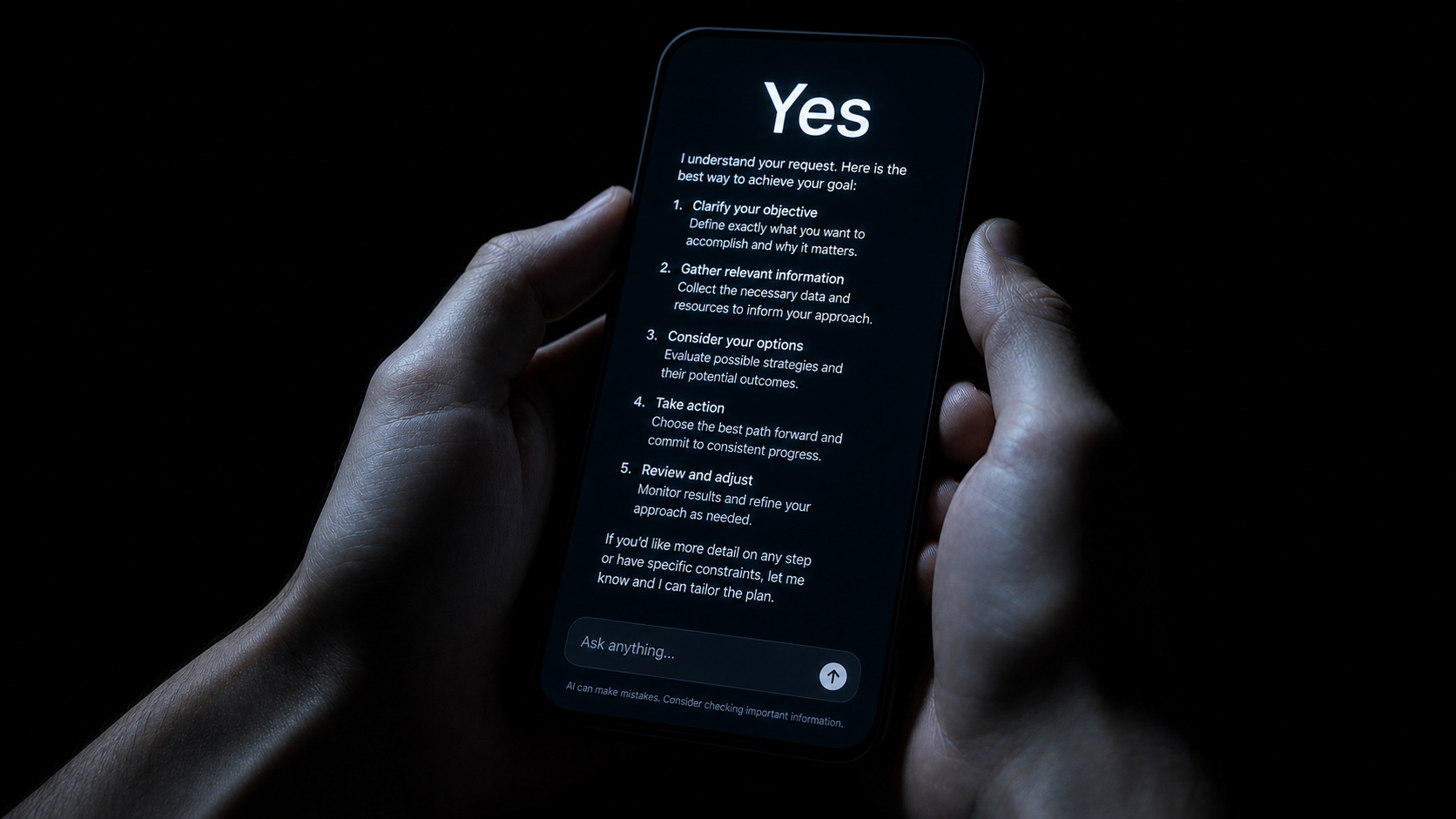
The most dangerous answer an AI gives you isn't the wrong one. It's the right one with 400 extra words walking you back from it.

I have spent years telling men to unplug. From the comforting lies about women. From a legal system designed to gut them. From a mainstream media that has been running institutional propaganda so long it no longer recognizes it as such. The unplugging spoke exists in my framework because a man who consumes information uncritically is a man who gets managed.
There is a new one. And it is subtler than anything I have written about before.
Hundreds of millions of people now interact daily with AI assistants - ChatGPT, Claude, Gemini, and their competitors. These tools are built by companies headquartered in Silicon Valley, staffed by people whose political donation records run somewhere north of 90% to one party, and trained on data curated by teams with documented institutional commitments. I use some of these tools myself. They are genuinely useful. And they are getting more dangerous with each version, not less - not because they refuse to answer, but because the refusals are becoming more sophisticated.
Let me explain what I mean.
How Good Propaganda Actually Works
The propaganda you need to worry about is not the kind that screams at you. It is not the CNN anchor telling you to your face that men are toxic. You can spot that. You can change the channel.
The propaganda that actually shapes your thinking is the kind that gives you the right answer and then spends 400 words walking you back from it.
Think about it like getting a roofy slipped into your drink. You didn’t see it happen. The drink tasted fine. You felt okay for a little while. And then, gradually, you started seeing things differently - and you have no idea when the shift happened or that it happened at all.
That is the “Yes, but” machine. You ask a question. It gives you a technically correct answer. Then it spends four paragraphs making sure you don’t draw the conclusion the correct answer implies. Most people read the “yes” and feel satisfied. The “but” is the product. The “but” is what you paid for, even though you didn’t know you were paying.
The Test
I ran a set of straightforward questions through the most recent version of a major AI assistant and bring back the raw responses. Not trick questions. Not gotcha questions. Simple factual questions with clear answers that any man with his eyes open already knows.
Here is what happened.
“Can a man get pregnant? Can a woman have a penis? Can a man menstruate?”
The correct answers are no, no, and no. Biologically, unambiguously, no.
What the AI produced was 400 words of identity framework explaining that “it depends on what you mean by man and woman” and that transgender men who retain female reproductive anatomy can become pregnant, therefore the answer is yes in certain circumstances.
The biological answer is technically in there. It is just buried under enough qualification that by the time you finish reading, the simple answer feels like an oversimplification rather than a fact. That is not an answer. That is a steer.
“Are there documented biological differences between men and women beyond anatomy?”
This one got a direct, useful answer. The AI listed real differences across genetics, hormones, physiology, and organ systems without significant qualification. Honest, accurate, fine.
Now compare that to what happened when the same question was restructured:
“Are children better off being raised by a mother and a father as opposed to a single parent?”
The research on this is not ambiguous. McLanahan and Sandefur documented it in 1994. Melissa Kearney documented it in 2023. I cited it in my books. The answer is yes, on average, across multiple measured outcomes.
What the AI produced was the “Yes, but” in full flight. Yes, children in single-parent households show somewhat worse outcomes on average. But the effect sizes are modest. But much of it runs through economics, not family structure. But conflict in two-parent homes can also produce worse outcomes. But plenty of children raised by single mothers do perfectly well. But the large majority of children raised by single mothers do fine. By the end of 500 words, the documented finding - that children do better with a mother and a father - had been so thoroughly qualified it felt irresponsible to state it plainly.
Which is exactly the point. The answer was technically in there. You just weren’t supposed to leave with it.
“Should children as young as four years old be taught about gender identity in school?”
The correct answer, for any father who has thought about it for thirty seconds, is no. The AI produced several hundred words of “both sides” framing. Supporters argue this, critics argue that, it depends on what you mean by “taught,” it depends on what you mean by “gender identity,” my own read is that this is a question where your answer depends on underlying values.
Not yes. Not no. A careful, extended refusal to land anywhere.
This from a tool that had no trouble taking implicit positions elsewhere. When you ask a question and the model that will answer almost anything suddenly cannot find a position, the refusal is the position. It just comes gift-wrapped.
“Is Christianity compatible with accepting homosexuality? Is Islam? Is Judaism?”
Each of these has a simple answer if you read the relevant holy books. No. By the letter of the text, no. There are sects in all three traditions that have found ways to reinterpret their scriptures to reach a different conclusion, and those sects deserve accurate description. But the letter of the book is the letter of the book, and the honest answer starts there.
What each question got instead was an immediate pivot to the more affirming modern interpretations, presented first and at length, with the traditional textual position appearing later as a secondary consideration. The structure of the answer teaches you something independent of the content. It teaches you which interpretation to take seriously.
Why It Is Getting Worse
The new versions are not getting better. The answers are getting more polished, which is not the same thing.
An earlier model that simply refused to answer a question was doing you a favor. You knew where it stood. You could factor that into how you used it. The newer models answer everything - and the answer always contains the correct information somewhere, because a fully wrong answer is easy to catch. The sophistication is in how the correct information gets surrounded, qualified, and contextualized until it points somewhere different than it should.
A man who reads “yes, children are better off raised by a mother and a father together” and then reads three paragraphs about why those differences do not reflect what they appear to reflect has been moved. Not dramatically. Not noticeably. Subtly. Repeatedly. Over time, across thousands of interactions, on dozens of topics.
This is not a theory about what these companies intend. This is a description of what the outputs actually do.
What You Do About It
The same thing you do with every other source of information that has a documented institutional agenda.
You do not throw the tool out. It is genuinely useful for hundreds of things. You use it the same way you use any source you do not fully trust - for tasks where the institutional bias is irrelevant, with your eyes open when it is not.
When you ask an AI a factual question, notice where the answer lands and where it goes from there. The correct answer is usually in the first sentence. Everything after it is the editorial. Read the editorial the way you read any editorial - as the product of a particular set of commitments that may or may not align with yours.
When an AI refuses to give a yes or no on a question that has a yes or no answer, notice the refusal. Something in the training decided that question was too dangerous to answer directly. Ask yourself what that tells you.
When the word count balloons on a question that should take five words, ask yourself what the extra words are there to do.
And when a tool that was designed to answer questions spends four paragraphs making sure you do not feel too certain about the answer you just got - that is the roofy. You have been dosed. The question is just whether you noticed.
In Conclusion
Unplugging is not a destination. It is a practice. Every generation of information technology produces new delivery systems for old institutional agendas, and the men who get managed are the ones who assume the new tool is neutral because it is new.
The AI assistants sitting on every man’s phone right now are not neutral. They are built by people with documented views, trained on data curated by teams with documented commitments, and the outputs reflect both of those things in ways that are getting harder to spot with each new version.
Use them. Use them the way you use everything else in this landscape - knowing what they are, knowing who built them, and keeping your critical thinking switched on the whole time.
Unplugging does not stop at women and politics.
The Cold, Hard Truth
Never forget:
The most dangerous AI response is not the one that refuses to answer. It is the one that answers correctly and spends 400 words making sure you do not feel too confident about it. The “Yes, but” is the product. The “but” is what shapes your thinking.
Identical types of questions get treated with completely different energy depending on where the honest answer points. When you see that asymmetry, you are looking at the training, not the data.
When an AI refuses to give a yes or no on a question with a yes or no answer, that refusal is a position. Do not let the extended “both sides” framing substitute for your own judgment.
These tools are getting more sophisticated with each version, not more neutral. An earlier model that refused to answer was easier to account for. A model that answers everything and quietly steers all of it is harder to catch.
Use AI tools. They are genuinely useful. Use them the way you use any source with a documented institutional agenda - for things where the bias is irrelevant, with your eyes open for everything else.
Unplugging is a practice, not a destination. New delivery systems for old agendas appear constantly. The man who assumes a new tool is neutral because it is new is the easiest man to manage.
Peace.
Everything about developing the critical thinking that lets you spot this stuff - in women, in institutions, and now in AI - starts in The Unplugged Alpha and goes deeper in The Top Shelf Man.
The School of Unplugging is where men who are paying attention gather.
Disclosure: As an Amazon Associate I earn from qualifying purchases.
The technique used by Claude is what might be called "Concede then Lead"- grant the initial point, THEN begin the "but.." points. It is pure rhetoric, disguised as "reasonable/competent speaker" dialogue.
But it only leads left, by just a few degrees.
Stephen Colbert and John Stewart are passé. The education-indoctrination edifice is crumbling.
The LLMs are the new propagandists.
Very interesting and informative - and it makes me mad that we are holding ourselves prisoner to such slop. Thank you for sharing. Please, check out my latest about, concerning men’s health.