
The Playbook Looks Familiar
Pre-positioned mRNA Vaccines, Pandemic Exercises, and a Cruise Ship Outbreak: Patterns Worth Watching

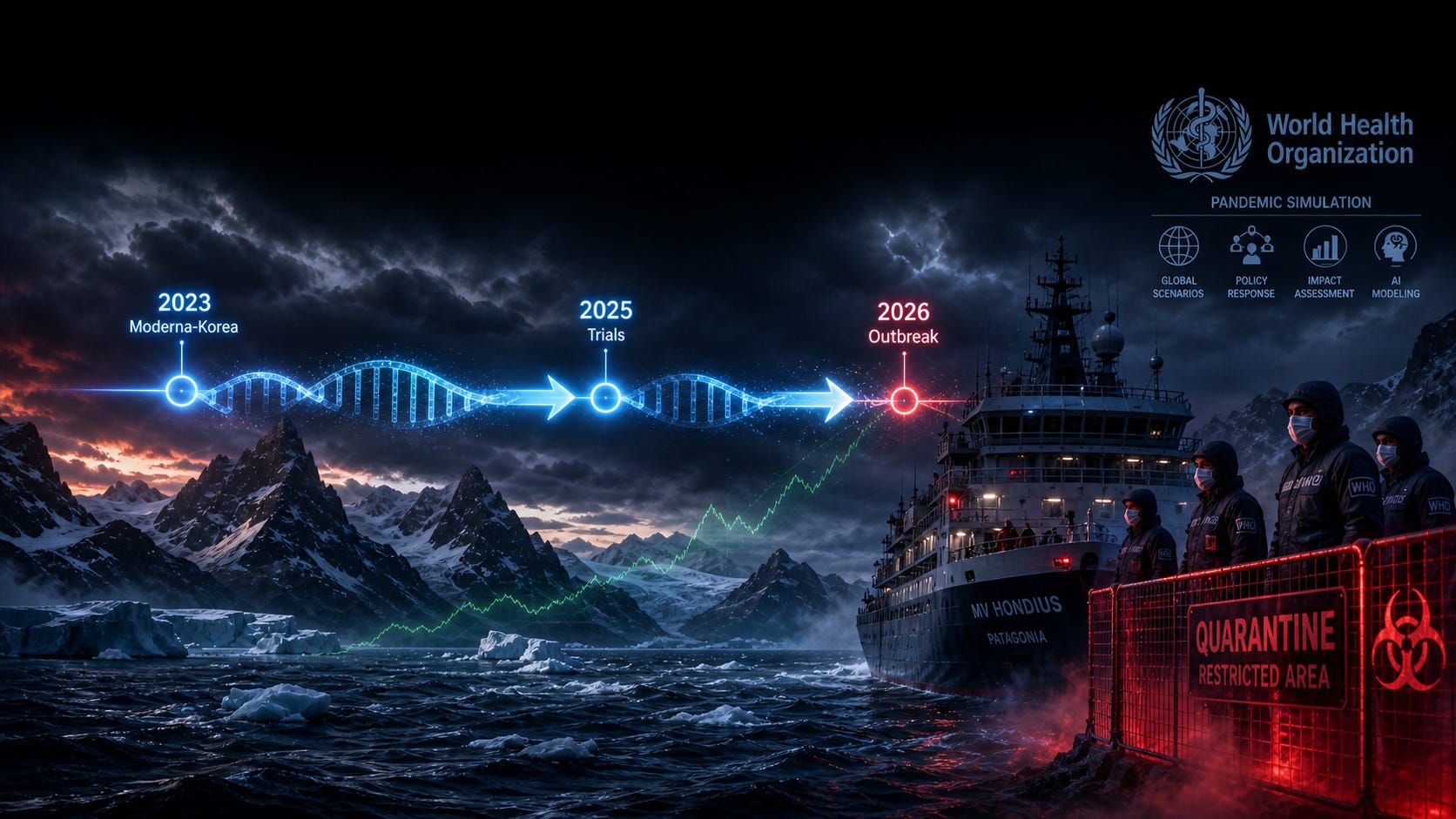
I have been watching something develop over the past few weeks that I want to share with you. Not because I am certain where it is going. I am not. But because the pattern I am seeing has shown up before, and I have some experience recognizing it.
In The Top Shelf Man, I wrote about COVID directly. Licensed professionals were "forced to take experimental vaccinations, that later on proved to be neither safe, nor effective - just to keep their careers." Within twelve months of lockdown, all of my friends with a location-independent business had moved out of Canada to a less restrictive business environment. That is what it looks like when you are positioned for exactly this kind of government overreach - and that experience applies directly to what I am watching develop right now.
Let me tell you what is documented, what is not, and what the pattern looks like from where I am sitting.
What Actually Happened
On April 1, 2026, the MV Hondius cruise ship departed Ushuaia, Argentina - the gateway to Patagonia. Within weeks, nine confirmed and two suspected cases of Andes virus had emerged onboard. Three people died. The ship’s passengers came from twenty-three countries and, by the time the outbreak was confirmed, had already dispersed globally.
One detail matters more than any other: Andes virus is the only hantavirus on earth with documented proof person-to-person transmission. And the ship departed from exactly the right endemic territory to acquire exactly this virus and carry it across twenty-three countries.
That is the factual starting point.
The Infrastructure That Was Already There
Here is where the pattern starts.
In September 2023 - two and a half years before the Hondius outbreak - Moderna signed an R&D agreement with the Korea University Vaccine Innovation Center to develop an mRNA hantavirus vaccine under Moderna’s “mRNA Access Program.” By July 2024, a full-scale collaboration was formally announced, with Moderna’s Chief Medical Officer personally present in Seoul. By February 2025, mouse trials confirmed experimental doses prevented infection.
Two patents already exist and are publicly filed:
Both filed before the outbreak.
There is also a military program: SAB-163, a pan-hantavirus antibody using transgenic cows, funded by USAMRIID since 2013. It is IND-enabled and ready for Phase 1 clinical trials. BARDA previously funded SAB Biotherapeutics for COVID to the tune of over $117 million. A hantavirus contract has not yet been announced. Watch for it.
Here is the question I keep coming back to: why would anyone patent and fund mRNA hantavirus vaccines before an outbreak, for a virus with approximately 900 documented US cases over thirty years? That is not a commercial market. No pharmaceutical company makes that investment on return-on-investment logic alone. The answer, if you look at the documentation, involves NIAID Category A biodefense classification, Disease X pre-positioning, and a military pipeline that has been quietly running since 2013.
The Exercises
Two pandemic preparedness exercise preceded the Hondius outbreak, and one more ran concurrently.
February 5-6, 2026: CEPI ran a Korea tabletop exercise described as a “fictitious deadly virus spreading fast,” focused on the 100-Day Mission - the framework for developing vaccines within 100 days of a pathogen being identified. Run by CEPI CEO Richard Hatchett alongside Korean MFDS, KDCA, and IVI Seoul. The same institutional cluster working with Moderna on the hantavirus vaccine program.
April 22-23, 2026: WHO Exercise Polaris II. Twenty-six countries. Six hundred experts. A fictional bacterium pandemic scenario. Results published April 27. The Hondius ship was already at sea with cases developing when this exercise concluded.
May 2026: US health department tabletops for FIFA World Cup outbreak scenarios, running concurrently with Hondius news breaking publicly.
For reference: Event 201 ran October 18, 2019. COVID emerged November 2019. Roughly two months. CEPI Korea ran February 5-6, 2026. Hondius outbreak confirmed early May 2026. Roughly three months.
I am not telling you those gaps prove anything. I am telling you they are worth noticing.
The Institutional Response
WHO Director-General Tedros personally flew to Tenerife to oversee the response to what was, at the time, eight to eleven cases on a single ship. Maria van Kerkhove - the same face from COVID - was running media.
This detail is worth sitting with. Eleven cases. One ship. The Director-General of the WHO. Personally. On a plane. To Spain.
There is also this: hantavirus is not currently on CEPI’s official priority pathogen list. Their list covers Chikungunya, coronaviruses, Disease X, filoviruses, Lassa, Mpox, Nipah, and Rift Valley Fever. Hantavirus is not there. Yet CEPI ran a Korea exercise with the exact institutional cluster developing hantavirus vaccines. The predicted next move, if this follows the established pattern, is a post-Hondius addition to that list. That is how Disease X gets a name.
Moderna’s stock surged on the outbreak news. “Emergency access and emergency approval” language has already been floated publicly.
The Treatment Question
In February 2022, Dr. Vladimir Zelenko - the American physician known internationally for his COVID treatment protocol - shared a message with what he called profound national security implications. He identified a category of viruses that all replicate using the same enzyme: RNA-dependent RNA polymerase, or RdRp. The list included COVID (all strains), influenza, RSV, Ebola, Marburg - and hantavirus.
His argument: zinc ionophores, including hydroxychloroquine, ivermectin, quercetin, and EGCG, inhibit RdRp activity. Cheap. Generic. Many available over the counter.
Zelenko died in June 2022. His claims about COVID treatment were vigorously disputed by mainstream medicine, and no high-quality clinical trials have established this approach specifically for hantavirus. The biological mechanism he identified - that hantavirus is an ssRNA virus dependent on RdRp for replication - is not scientifically disputed. Whether zinc ionophores meaningfully inhibit that mechanism in humans is a different and unanswered question.
What is notable is not whether Zelenko was right. What is notable is that this line of inquiry - whether any existing, cheap, generic treatment might be relevant - is entirely absent from current expert commentary and media coverage of the Hondius outbreak. Given what we watched play out during COVID, that absence is a data point.
If you want to understand why cheap existing treatments disappear from the conversation, understand this: an effective existing treatment kills the Emergency Use Authorization pathway. The EUA pathway is what creates the liability shield. And the liability shield is what makes a $20 billion vaccine rollout financially viable for the companies that have been quietly building the infrastructure for the past two and a half years.
What We Know, What We Don’t, and What We Can Reasonably Suspect
I am going to be straight with you about what falls into each category.
Documented facts: Moderna and Korea University have been developing mRNA hantavirus vaccines since September 2023. The patents are publicly filed. The SAB-163 military program has been running since 2013. Two pandemic exercises preceded the outbreak. WHO’s response to eleven cases involved its Director-General flying to the site personally. Moderna’s stock surged. Emergency authorization language is being floated. A NIH grant (U54-AI065359) has been funding hantavirus reverse genetics and reassortant research in parallel.
What we do not know: Whether this follows the COVID trajectory. Whether the EUA push materializes. Whether the institutional response remains proportional or escalates. Whether the case count stays contained or expands. Whether the cheap treatment question gets asked publicly by anyone with a platform large enough to matter.
What we can reasonably suspect: The same institutional logic that drove the COVID response is present here. The players are largely the same. The sequence is the same. The financial incentives are the same. Whether this becomes a full-scale repeat of 2020 depends on factors that are not yet determined - primarily whether the virus spreads meaningfully beyond the initial cluster, and whether the public, having watched the last round, asks harder questions faster this time.
I have said for years that the comforting lies sell better than the uncomfortable truths. The comforting lie here is: eleven cases, one ship, contained. The uncomfortable question is: why does a virus with 900 US cases in thirty years have a fully pre-positioned mRNA vaccine pipeline, military funding, and the personal attention of the WHO Director-General?
What You Should Do
Watch the case count. If this stays contained and fades from the news cycle within a few months, the infrastructure will stand down and wait for the next opportunity. That has happened before.
If it does not - if case counts begin climbing, if travel restrictions enter the narrative, if the FDA begins fast-tracking emergency approvals, if CEPI quietly adds hantavirus to its priority pathogen list - you will know what you are looking at.
The anti-fragility framework from The Top Shelf Man covers exactly this scenario: multiple passports, distributed assets, health resilience, and zero dependence on the pharmaceutical system for your baseline function. The men who were physically capable, metabolically healthy, and not waiting for a government agency to tell them what to put in their bodies navigated COVID better than the men who weren’t. The same principle applies here regardless of where this goes.
Do not wait for mainstream media to tell you what to make of this. They were not asking these questions in 2019 either.
Unplug.
In Conclusion
I am not predicting a repeat of 2020. I am watching a pattern and sharing what I see.
The infrastructure for a hantavirus vaccine program was quietly pre-positioned before a single case appeared on the Hondius. The exercises ran. The institutional response arrived faster and at a higher level than eleven cases on one ship would ordinarily warrant. The cheap treatment question is not being asked. The stock surged.
What I know from a decade of watching how government, pharmaceutical companies, and mainstream media operate is this: they do not move at the speed they have moved on hantavirus unless there is something in it for them. Nine hundred cases over thirty years does not justify what has been built. Something else does. And if you have been paying attention since 2020, you already have a good idea of what that something else looks like.
Make of it what you will.
The Cold, Hard Truth
Never forget:
Moderna signed an agreement to develop an mRNA hantavirus vaccine in September 2023, two and a half years before the Hondius outbreak. The patents were filed before anyone had heard of this ship. Ask why a virus with 900 US cases in thirty years warranted that level of pharmaceutical infrastructure investment before there was a market to justify it.
Two pandemic preparedness exercises preceded the outbreak. Event 201 preceded COVID by two months. Exercises are supposed to prepare for outbreaks. The question is which direction that causation runs.
The WHO Director-General flew personally to Tenerife for eleven cases on one ship. Disproportionate institutional response is a signal. It was a signal in 2020. It is a signal now.
Hantavirus is not on CEPI’s priority pathogen list. Yet CEPI ran a Korea exercise with the exact institutional cluster building the hantavirus vaccine program. Watch for the post-Hondius addition to that list. That is how Disease X gets a name and how a pre-built pipeline gets activated.
The absence of any discussion of existing treatment approaches in current coverage follows the same logic we saw in 2020. Effective existing treatments kill the EUA pathway. The EUA pathway is what makes the numbers work for the companies that built the infrastructure.
None of this is certain. All of it is a pattern. Unplugged men watch patterns. They do not wait for permission to ask the questions that need asking.
Peace.
The framework for navigating exactly these scenarios - anti-fragility, government trends, health resilience, and positioning yourself before you need to be positioned - is in The Top Shelf Man.
Everything about unplugging from the comforting lies - in relationships, government, media, and pharmaceutical narratives - is in The Unplugged Alpha.
If you want to be in a room where these conversations are happening with men who are paying attention - The School of Unplugging is where that happens.
Disclosure: As an Amazon Associate I earn from qualifying purchases.
Good catch
I like the direction your moving in Rich, we need to be red pilled in all areas of life, especially when it comes to the deep state and the war against normal people.