
How To Run Your Own Paternity Test - Privately, At Home

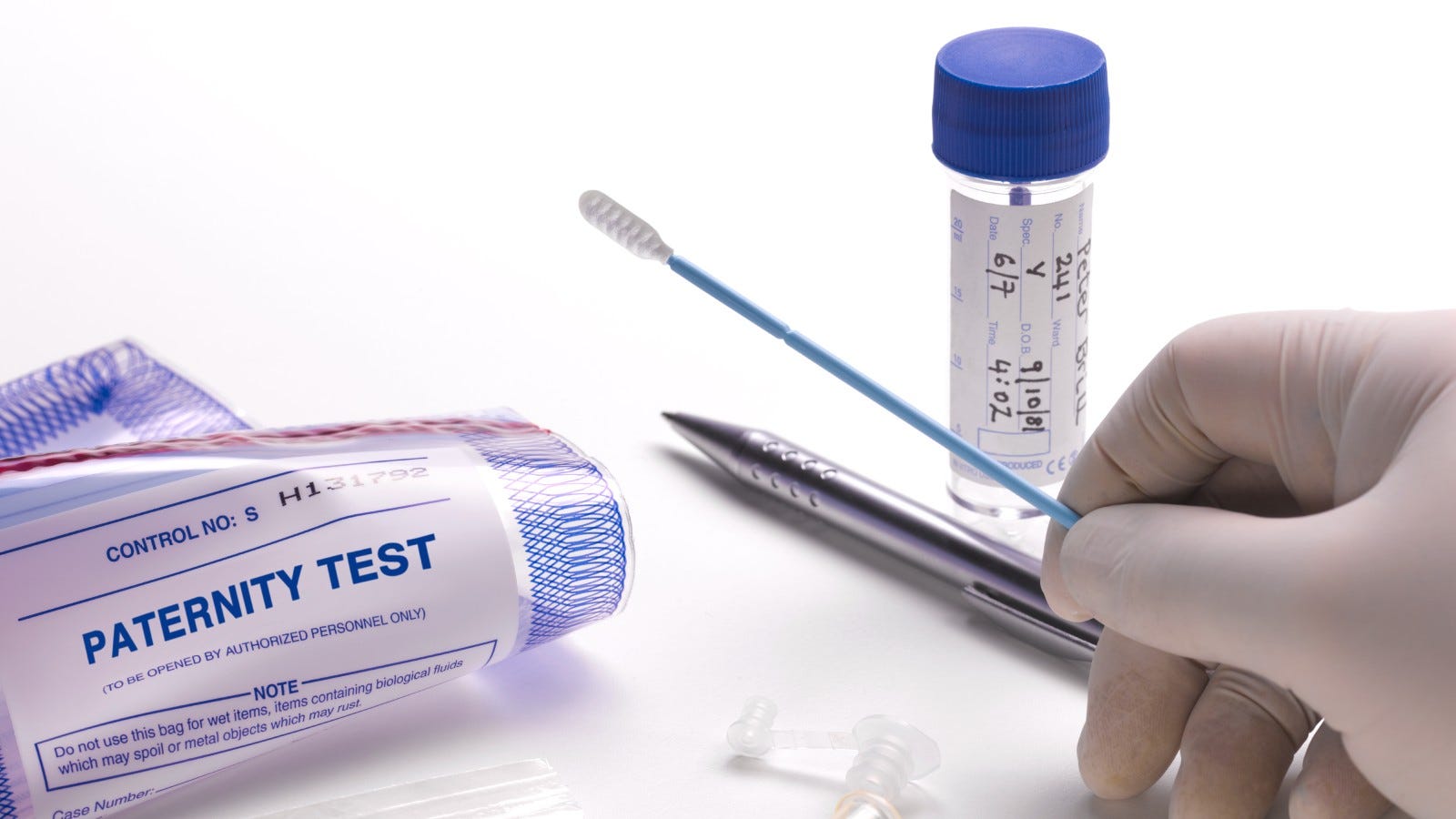
A friend of mine read my last article on paternity fraud and sent me a message that caught my attention. He said, “Rich, you laid out the problem. The stats are terrifying. But you didn’t tell anyone what to do about it. There’s actually a way to run your own paternity test at home, on your laptop, with no lab involved, no record, and no one ever knowing you checked.”
I didn’t know about this. Most men don’t. So I asked him to walk me through it, and what he showed me was so straightforward and so accessible that I knew I had to share it.
If you read the last article, you'll remember the Guerrini study - over 23,000 people who used FamilyTreeDNA's relative-finder service found that 3% of them discovered an unexpected biological parent. Those people weren't looking for trouble. They bought a DNA kit to find out if they were part Irish. What I'm about to show you is how to look deliberately.
But before we get to the method, I need to talk about why this matters so much - in several Western countries, the government has decided that you don’t have the right to know if your child is biologically yours.
The Countries That Made It a Crime to Know
In my previous article, I covered the French and German paternity testing restrictions. But I want to go deeper here, because the legal landscape around this is worse than most men realize.
France is the most extreme case. Under Article 16-11 of the French Civil Code, identifying a person by their genetic fingerprints is restricted to criminal investigations, medical research, and court-ordered civil proceedings. Private paternity testing is a criminal offense. If you order a test, you face up to one year in prison and a fine of up to €15,000 under Article 226-28 of the Penal Code. If you simply request one - say, buying a kit online - that’s a separate offense under Article 226-28-1 carrying a fine of up to €3,750. This applies whether you collect the sample yourself, mail it to a lab, or ask someone else to do it on your behalf.
France did pass a bioethics reform in 2025 that slightly modified the procedural rules, but the core restriction remains. The only legal path to a paternity test still runs through a judge who must order it as part of a formal court proceeding. A French man cannot walk into a lab and find out if his child is his. The French Council of State has described this law’s purpose as upholding the “French regime of filiation” and preserving “the peace of families.”
Preserving the peace of families. Not preserving the truth. Not preserving the rights of fathers. Preserving the peace - which is another word for preserving the lie.
Germany operates under the Genetic Diagnostics Act of 2009. Paternity tests require the written consent of all parties involved, which means a father cannot test his own child without the mother’s knowledge and explicit agreement. Secret testing is illegal and carries fines of up to €5,000. The results of any unauthorized test are inadmissible in court. A man who suspects he’s not the biological father can petition a court, but doing so requires involving the mother - the very person who may be maintaining the deception.
Switzerland follows a similar model. Under the Federal Law on Human Genetic Analysis (LAGH), paternity tests require informed consent from all adults involved. Swiss labs will not process a test without documented consent from every party. Secret testing is prohibited. Direct-to-consumer genetic tests are largely banned in Switzerland, though many Swiss residents order tests from companies outside the country anyway.
Now notice the pattern here. In every one of these jurisdictions, a woman who commits paternity fraud - who knowingly allows a man to believe he is the father of a child that is not biologically his, who accepts his financial support, his emotional investment, his years of sacrifice under false pretenses - faces no criminal penalty whatsoever. Zero. There is no law against it. But a man who tries to discover whether he’s been deceived faces prison time and thousands in fines.
A woman can commit the fraud freely. A man can be jailed for uncovering it. Let that sink in and draw your own conclusions about whose interests the system is designed to protect.
The contrast: In the United States, private paternity testing is legal in all 50 states. New York is the most restrictive - the state Department of Health prohibits the sale of at-home paternity test kits and requires DNA collection for parentage testing to be performed by an approved collector with a doctor's or lawyer's order. It's not a criminal offense like France, but it's the closest any US state gets to restricting access.
The Method No One Told You About
Here’s what my friend showed me, and I’ve verified this with people who understand the genetics. This is real, it works, and it’s based on a principle so fundamental to biology that there’s no ambiguity in the results.
The principle is this: a biological parent must share at least one allele - one version of a gene - with their child at every single genetic marker. This is basic Mendelian genetics. You got half your DNA from your mother and half from your father. At every position on your genome, you carry two copies - one from each parent. That means at every testable position, a true biological parent and their child will share at least one of those two copies. Always. No exceptions.
If they don’t share an allele at a given position, geneticists call that IBS0 - Identity By State equals zero. For a real parent-child pair, IBS0 should be essentially 0%, with the exception of no more than a tiny fraction attributable to genotyping errors or data noise. For two unrelated people from the same population, IBS0 on consumer SNP arrays will typically land between 2-4%.
This is not a probability game. This is not “maybe” territory. If you compare two DNA files and the IBS0 rate comes back above 1.5%, that is not a parent-child relationship (absent a severe data quality issue). Mendel doesn’t lie.
Step 1: Get two consumer DNA tests.
Any major provider works - 23andMe, AncestryDNA, MyHeritage, LivingDNA. They cost between $99 and $199 each. You need one for the potential father and one for the child. These tests analyze around 600,000 to 700,000 genetic markers (SNPs) - more than enough data to determine a biological relationship with near-perfect accuracy.
Step 2: Download the raw data files.
Every major provider has a “download raw data” option somewhere in their account settings. When you download it, you get a text file - just columns of data showing chromosome, position, and genotype for each marker tested. This is your data. You purchased it, you own it. Two people having their own DNA files on their own computers is not a paternity test. It’s two people who bought a consumer product and downloaded a text file.
Step 3: Compare the files.
This is where it gets interesting. You can copy the prompt below into any AI chatbot - Claude, ChatGPT, whatever you use - and it will generate a working Python script in about 30 seconds that does the comparison for you. The script reads both files, finds the genetic markers they have in common, checks how many alleles are shared at each one, and gives you a plain-English result.
Here’s the prompt:
Write a Python script that compares two consumer DNA raw data files to determine
if the two individuals have a parent-child biological relationship.

REQUIREMENTS:
1. Accept two file paths as command-line arguments
2. Auto-detect the file format (support 23andMe, AncestryDNA, MyHeritage,
   LivingDNA, and generic tab/comma-separated formats with columns for
   rsid/chromosome/position/genotype)
3. Parse both files and extract autosomal SNP data only (chromosomes 1-22,
   skip X, Y, MT)
4. Find overlapping SNPs between the two files (match by rsID ONLY —
   do NOT match by chromosome+position, as build mismatches between
   providers will produce false matches and corrupt the results)
5. For each overlapping SNP, determine IBS (Identity By State):
   - IBS0: zero alleles shared (e.g., AA vs BB, or CC vs TT)
   - IBS1: one allele shared (e.g., AA vs AB)
   - IBS2: both alleles shared (e.g., AA vs AA, or AB vs AB)
6. Handle strand flips (A/T and C/G ambiguity) — either skip ambiguous
   SNPs or attempt strand correction
7. Skip any SNPs where either file shows no-call, deletion, or insertion
   (keep only clean biallelic calls)

OUTPUT:
- Total overlapping SNPs compared
- IBS0 count and percentage
- IBS1 count and percentage
- IBS2 count and percentage
- Clear verdict:
  * IBS0 < 0.5%: "RESULT: CONSISTENT WITH PARENT-CHILD RELATIONSHIP
    (Confidence: HIGH — [X] markers compared, [Y]% IBS0)"
  * IBS0 0.5-1.5%: "RESULT: INCONCLUSIVE — Possible parent-child with
    data quality issues, sibling, or relative. Consider retesting.
    ([X] markers compared, [Y]% IBS0)"
  * IBS0 > 1.5%: "RESULT: NOT A PARENT-CHILD RELATIONSHIP
    (Confidence: HIGH — [X] markers compared, [Y]% IBS0)"
- Also classify the most likely relationship based on IBS0 alone:
  * IBS0 < 0.5%: Parent-child or identical twins
  * IBS0 0.5-1.5%: Inconclusive — retest recommended
  * IBS0 > 1.5%: Not parent-child

ADDITIONAL:
- No external dependencies beyond Python standard library (no numpy,
  no pandas — this should run on any machine with Python installed)
- Include clear comments explaining the genetics for non-technical readers
- Print a progress indicator since files can be large
- At the end, print a plain-English summary a non-scientist can understand
You don’t need to understand the code. You just need Python installed on your computer, which is free (macOS already has it). The script does the rest.
Here is the result produced by the prompt above with Claude Opus 4.6 - it works and has been tested on 23andMe data files.
Save the source code to a local file and name it paternity_check.py. Execute the code with the following command:
python3 paternity_check.py dna_file_1.txt dna_file_2.txt
Step 4: Read the result.
The script will tell you three things: how many genetic markers were compared, what percentage showed zero shared alleles (IBS0), and a plain-English verdict. Here are example results from two unrelated people, and from a parent and a child.
IBS0 below 0.5%: Consistent with a parent-child relationship. According to peer‑reviewed research, SNP array genotyping error rates are approximately 0.1% (Saunders, Brohede & Hannan, Genomics, 2007), and confirmed parent–child pairs on these arrays display negligible IBS0 after standard quality control (Stevens et al., PLOS Genetics, 2011). Consumer SNP‑array platforms typically achieve genotype concordance of at least 99.5% for common variants. Accordingly, low levels of IBS0 in confirmed parent–child pairs are overwhelmingly attributable to technical artefacts (e.g. genotyping error or sample mis‑labelling) rather than true biological absence of relatedness.
IBS0 between 0.5% and 1.5%: Inconclusive. Could be a parent-child pair with noisy data, full siblings, or another close biological relative. Consider retesting with a different provider.
IBS0 above 1.5%: Not a parent-child relationship. Unrelated same-population individuals typically show 2-4% IBS0 on these arrays. Anything above 1.5% is well beyond what typical consumer genotyping error can explain.
Anything above 50,000 overlapping markers provides reasonably high confidence in the result. Most consumer DNA tests will give you hundreds of thousands of overlapping markers when comparing two files from the same provider.
But How Do I Get My Kid to Do It?
This is the question every man reading this is already asking, so let’s address it directly.
If your child is an infant or toddler, this is simple. Consumer DNA kits use a saliva sample or a gentle cheek swab. An infant or a toddler is not likely to protest enough to cause a problem.
But what about an older child? Your nine-year-old, your twelve-year-old? You can’t exactly pin him down and swab his cheek without creating a scene that raises questions you won’t want to answer.
You don’t need to. You frame it as exactly what the product is marketed as - a fun family activity about ancestry and heritage.
“Hey, I got us these ancestry kits - let’s find out where our family comes from. Maybe we’re part Viking. Maybe we’re part something we never expected. Spit in the tube, we’ll send it off and see what comes back.”
Kids love this stuff. It’s a science experiment. It’s a surprise reveal. It’s the kind of thing families post about on social media every day. There is nothing suspicious about a father and child doing an ancestry test together. Millions of families have done it. AncestryDNA, 23andMe, and MyHeritage all market specifically to families as a shared experience.
You could even frame it as a gift. Buy the kid a kit for his birthday or for Christmas - “I thought this would be cool, let’s find out what we are.” You do your own kit separately, at a different time, maybe even through a different provider. Two totally unconnected purchases. Nobody thinks twice about it.
The point is this: you are buying your child a normal consumer product that is sold to millions of other consumers every year. The fact that you’re also going to compare the raw data files on your laptop afterward is between you and your computer - no one else needs to know!
What This Means for Privacy
Let me be clear about what this process involves and what it doesn’t.
Yes, there is a lab. Yes, you mail a saliva sample. Yes, that data exists on a company’s servers. You are purchasing a consumer ancestry and health product, and that product works the same way it works for the millions of other people who buy it every year. There is nothing unusual about two people in the same household owning DNA test kits - millions of families have done it.
But here’s where the privacy advantage comes in.
The two kits do not need to be connected in any way. You can buy them at different times, from different providers if you want, with separate payment methods, shipped to separate addresses. You can register a kit under any name you choose. Several services - including MyHeritage and LivingDNA - have straightforward raw data download options and do not require extensive personal verification. If you want to go further, you can pay with a prepaid debit card purchased with cash and use an email address created for this purpose.
One critical detail: do not opt in to any relative-matching or "DNA Relatives" feature on either account. Most major providers run automatic algorithms that detect and flag parent-child relationships between users on the same platform. If the child's mother also has an account on that service, she could receive a notification about a new close match. Use different providers for each kit, register under names that are not your own, and skip every relative-matching prompt during account setup. Most consumer DNA services do not verify your identity against the name on your account - they verify your sample against the name and contact information you provide.
Once both kits have been processed - which typically takes two to six weeks per kit - you download the raw data files from each provider. Every major service offers this. You now have two text files on your computer.
From that point forward, there is no lab involved. The comparison happens on your laptop, using a script that runs locally. No data is uploaded anywhere. No third party sees the comparison. No record of a “paternity test” exists. What exists is two people who purchased consumer ancestry products - something roughly 30 million people worldwide have done - and a text file comparison that ran on a personal computer.
After downloading the raw data, you can delete both accounts, request destruction of your physical samples (most major providers offer this), and wipe the files from your computer once you have your answer. The two kits were never connected. The comparison was never online. No one ever needs to know it happened.
In jurisdictions where paternity testing is banned, this likely exists in a legal gray area. You did not order a “paternity test.” You did not submit samples to a paternity testing lab. You purchased consumer ancestry products that are legally available and widely sold. The comparison itself is a statistical analysis of files you own, run on hardware you own. Whether courts in restrictive jurisdictions would view it that way is an open question, and I am not going to pretend to know the answer. This is an educational article about genetics and consumer data analysis, not legal advice. If you live in a jurisdiction with restrictions on genetic testing, consult a lawyer before taking any action.
Why This Matters
Every man has the right to know if he is raising his own biological child. That should not be a controversial statement. In any other context, we would call the deliberate concealment of information this significant what it is - fraud. If a business partner hid financial information of this magnitude from you, they would face criminal charges. If an employer deceived you about the terms of your contract at this level, you would have legal recourse. But when a woman conceals the biological paternity of a child from the man she expects to raise and financially support that child, the legal system in multiple Western countries has decided that she deserves protection and he deserves punishment and possibly prison time for even trying to find out.
The technology to discover the truth now exists on every laptop in the world. The data costs as little as $99 per person. The comparison takes less than a minute on any modern laptop.
The only question is whether or not you want to know.
The Cold, Hard Truth
Never forget:
Across seventeen peer-reviewed studies, the median rate of misattributed paternity is 3.7%. When men who suspect something is wrong actually test, the non-paternity rate jumps to 17-33%, with a median of 26.9%.
A biological parent must share at least one allele with their child at every genetic marker. This is not statistics. This is not probability. This is Mendelian law.
Multiple Western governments have criminalized a man’s right to know if his child is biologically his - while imposing zero criminal penalty on the woman who deceived him.
Two consumer DNA files and a free Python script can answer the question privately, definitively, and without anyone ever knowing that you asked.
Nobody is coming to protect you on this one. The system was not built for you. Protect yourself.
This article is for educational and informational purposes only. It is not legal advice. Laws regarding genetic testing vary by jurisdiction and are subject to change. Consult a qualified legal professional in your jurisdiction before taking any action related to genetic testing.
Peace.
The full antifragility framework - applied to business, wealth, health, and relationships - is in The Top Shelf Man.
The foundation is in The Unplugged Alpha.
The School of Unplugging is where men building antifragile lives gather.
Disclosure: As an Amazon Associate I earn from qualifying purchases.
What an amazing contribution!
Rich, Great post. This needs to be a chapter in every one of your books and posted to your website. Keep up the great work. Paul.